

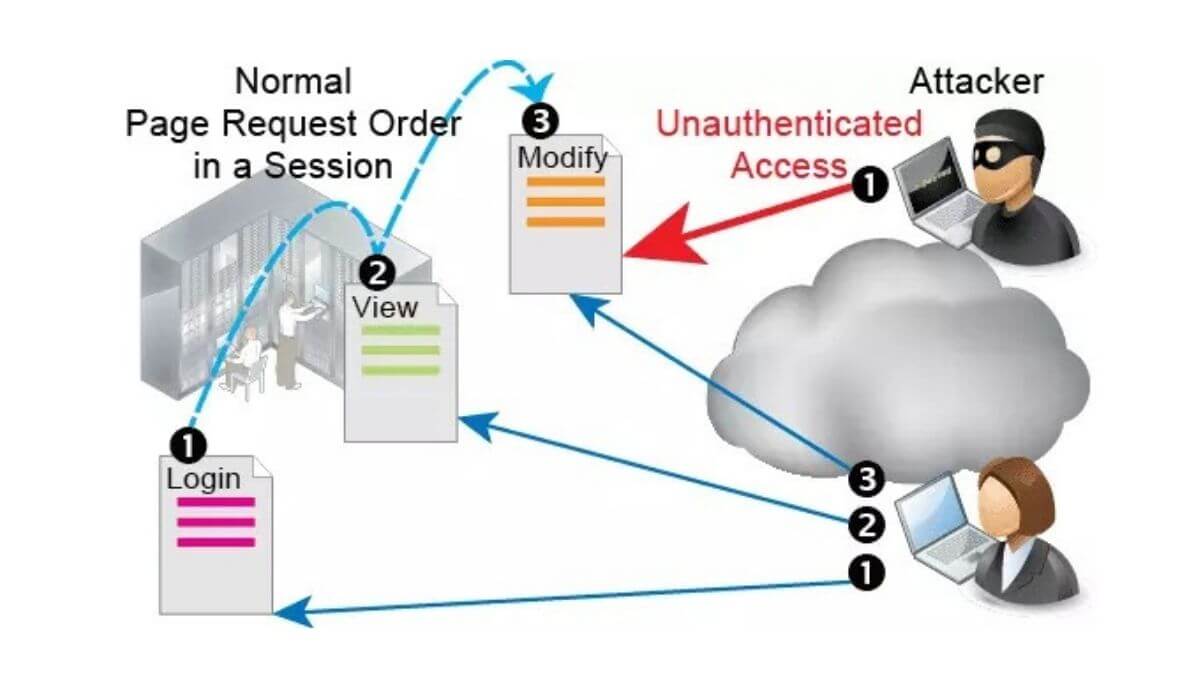
Sidejacking attack or session hijacking is the process of stealing someone’s access to a website with a remote service by intercepting and using the credentials that identified the user/victim to that specific server.
Key Takeaway: What Is Sidejacking and Session Hijacking?
Sidejacking is a specialized session hijacking attack where an adversary sniffs unencrypted HTTP session cookies over an unencrypted local network—such as public Wi-Fi—to impersonate an authenticated user without cracking their password. Attackers replay stolen session identifiers to bypass authentication barriers, gaining full access to target web applications and user data.
- Passive Packet Eavesdropping: Sidejacking relies on passive packet capture of unencrypted HTTP headers, leaving zero anomalous log footprints on target application servers during initial interception.
- Credential-Free Account Takeover: Adversaries bypass multi-factor authentication (MFA) prompts entirely because stolen session tokens represent an already authenticated, valid browser state.
- Mandatory Cryptographic Protection: Neutralizing sidejacking requires universal TLS 1.3 encryption, strict HTTP Strict Transport Security (HSTS), and cookie attributes like
Secure,HttpOnly, and__Host-prefixes.

Usually, sidejacking attacks are performed through accounts where the user types in their username and password.
Session sidejacking is a type of security threat in which an attacker hijacks a session by intercepting and reading network traffic between two parties to steal the session cookie.
The attacker can now make use of your cookie to impersonate your account and can do everything a user can do when logged in to any website. Sidejacking attacks work to find a nonsecure sockets layer (SSL) cookie.
To Sidejack access to a website, the bad actor uses a packet sniffer to obtain an unencrypted cookie that grants access to a website.
SideJacking is most common on sites that require authentication through a username and password, such as online Webmail accounts as well as social networking sites.
Victims of identity theft can suffer financial losses, while the related sites may face litigation and negative publicity
How do you Prevent Sidejacking or session hijacking
- Use only websites that are using Valid SSL.
- Use a virtual private network (VPN) while using Public Wi-Fi.
- Always Log out of websites when done.
- Data between Server and the browser should be encrypted.
Session Hijacking Taxonomies: Sidejacking, Session Fixation, XSS Theft & Defense Matrix
Session hijacking spans network packet eavesdropping, client-side script execution, and protocol manipulation. The technical matrix below contrasts sidejacking against complementary session hijacking vectors, highlighting modern cryptographic defenses and authentication controls:
Deep Dive: Modern Cookie Hardening & Cryptographic Token Binding
Sidejacking emerged in 2010 when tools like Firesheep demonstrated that even if a website encrypted its initial login form over HTTPS, subsequent navigation reverted to unencrypted HTTP. Today, protecting session integrity against eavesdropping and token replay requires comprehensive application-layer cookie architecture:
- The
__Host-Cookie Prefix Standard: Browsers reject any cookie with the__Host-prefix unless it is set withSecure, originates from an HTTPS origin, does not specify aDomainattribute (preventing subdomain inheritance), and specifiesPath=/:Set-Cookie: __Host-SessionId=a9f73c41de8204b7; Secure; HttpOnly; SameSite=Strict; Path=/ - HTTP Strict Transport Security (HSTS) with Preloading: Enforce strict TLS across the root domain and all subdomains, preventing protocol downgrade attacks:
Strict-Transport-Security: max-age=63072000; includeSubDomains; preload - OAuth 2.0 Demonstrating Proof-of-Possession (DPoP – RFC 9449): Replaces static bearer tokens with public-key cryptography. The client browser generates an ephemeral asymmetric key pair and signs each HTTP request with a private key proof (DPoP header). Even if an attacker intercepts or steals the access token, they cannot replay it without possessing the private key stored securely inside the client’s Web Crypto subsystem.
Related Technical Guides & Architecture Deep Dives
Explore our interconnected engineering guides, protocol analyses, and benchmark comparisons across the Networking, VPNs, Browsers & Privacy knowledge cluster:
- What is VPN (Virtual private network)A Virtual Private Network (VPN) establishes an encrypted point-to-point tunnel across public networks, encapsulating and protecting packet payloads…
- What is WHOIS and How to lookup whoisA whois lookup domain intelligence rfc 3912 query retrieves administrative registration data for domain names, IP address allocations, and autonomous…
- 10 Best Android Browsers in 2026: Speed, Privacy & Feature ComparisonQuick Answer: What Are the Best Android Web Browsers in 2026?
- 10 Best Free VPN for 2026The best and safest free VPN in 2026 is Proton VPN Free, which provides unlimited data bandwidth, a verified strict zero-logs policy audited by…